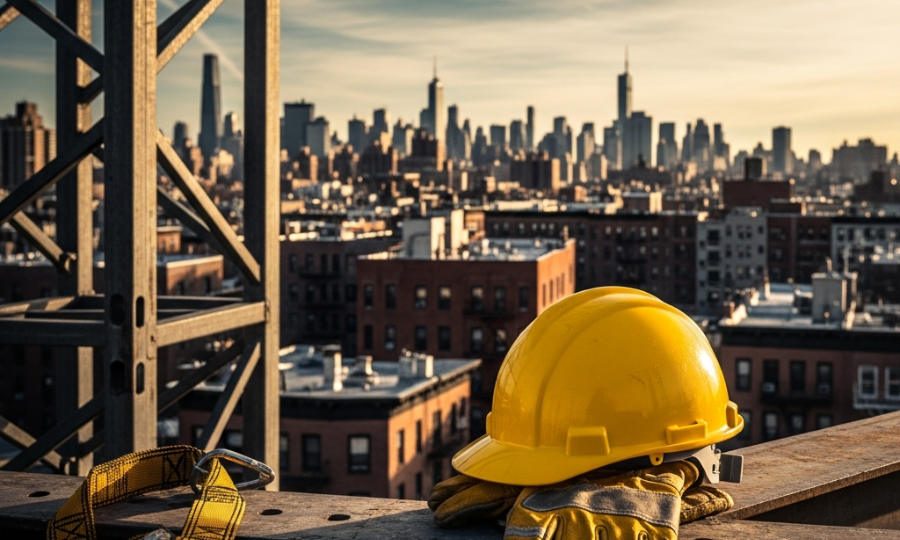
New York City‘s skyline is a testament to the tireless work of countless construction professionals. However, this constant building activity comes with inherent dangers. Every day, construction workers face risks, especially those working at elevated heights. Sadly, falls remain the leading cause of construction deaths in New York City. In 2024, 19 construction workers died in New York City, a decrease from 30 fatalities in 2023, which was the highest total in a decade, according to the New York Committee for Occupational Safety and Health (NYCOSH).
Key Takeaways
- New York’s Labor Law 240, known as the Scaffold Law, imposes absolute liability on property owners and general contractors for gravity-related construction accidents, protecting injured workers.
- Falls are the leading cause of construction fatalities in New York City, accounting for 58% of all construction worker deaths, according to the Law Offices of Brett J. Nomberg.
- Labor Law 240 claims allow injured workers to seek comprehensive compensation, including pain and suffering, beyond workers’ compensation benefits, with average settlements exceeding $1.2 million in 2024.
- Contacting an experienced NYC personal injury lawyer immediately after a construction fall is crucial to investigate the accident, preserve evidence, and maximize compensation.
Fortunately, New York State offers powerful legal protection for these workers through Labor Law 240, commonly known as the ‘Scaffold Law.’ This unique statute provides a critical advantage for accident victims, ensuring they can seek maximum compensation. Indeed, the top 15 New York personal injury outcomes in 2024 and 2025 totaled more than $1.1 billion, with construction cases dominating due to Labor Law 240’s impact, according to reports aggregating verdict and settlement data. Our firm understands the profound impact a construction accident can have on a worker and their family. We are here to guide injured individuals through the complexities of the Scaffold Law, helping them secure the justice and financial support they deserve.
Understanding New York Labor Law 240, The Scaffold Law
New York Labor Law 240 is a foundational piece of legislation designed to protect workers from gravity-related accidents on construction sites. Enacted in 1885, this law places strict responsibility on property owners and general contractors to provide adequate safety devices for workers performing tasks at heights. This includes, but is not limited to, scaffolding, ladders, hoists, ropes, and safety harnesses. The law’s reach extends beyond just scaffolds, covering any situation where a worker is exposed to a fall from an elevated surface or is struck by a falling object.
The Scaffold Law is distinct because it imposes what is known as ‘absolute liability’ on owners and general contractors. This means that if a worker is injured in a gravity-related accident and proper safety devices were not provided or adequately maintained, the owner and contractor are held fully responsible. Unlike typical negligence claims, the injured worker’s own potential comparative fault is generally not a defense under Labor Law 240. This absolute liability framework is a cornerstone of worker protection in New York, setting it apart from many other states.
The types of work covered under Labor Law 240 are broad. They include erection, demolition, repairing, altering, painting, cleaning, and pointing of buildings or structures. For instance, if a worker is painting a building in Brooklyn and falls because a ladder slips, or if a worker in Queens is struck by falling debris due to inadequate overhead protection, Labor Law 240 may apply. The law is designed to protect those who are most vulnerable on a job site and often lack the power to dictate safety measures.
The Critical Impact of Absolute Liability for Injured Workers
The concept of absolute liability under New York Labor Law 240 is immensely significant for injured construction workers. It fundamentally shifts the burden of proof in many fall-related and falling object accidents. This means that if you are injured in a qualifying incident, you generally do not need to prove that the owner or contractor was negligent in the traditional sense. Instead, you primarily need to demonstrate that a safety device was not provided or was inadequate, and this failure contributed to your injury.
This legal standard is a powerful tool for accident victims seeking compensation. It ensures that those in control of the worksite, who are best positioned to ensure safety, are held accountable when gravity-related injuries occur. For example, if a worker in Manhattan falls from a scaffold that was not properly secured, the property owner and general contractor could face absolute liability, even if they were not directly present at the time of the incident.
Also, Labor Law 240 claims are separate from workers’ compensation benefits. While workers’ compensation covers medical expenses and a portion of lost wages, it does not typically compensate for pain and suffering or full lost income. A successful Labor Law 240 lawsuit allows injured workers to pursue these additional damages, providing a more comprehensive recovery for their losses. This distinction is crucial for victims facing long-term injuries and significant life changes.
Common Construction Accidents Covered by the Scaffold Law
Falls are a persistent and tragic reality on New York construction sites. Data consistently shows them as the leading cause of fatalities. In New York City, falls account for 58% of all construction worker fatalities, with common scenarios involving scaffolds, ladders, unprotected floor openings, and roofs, according to the Law Offices of Brett J. Nomberg. The New York City Department of Buildings (DOB) reported that in 2020, fall accidents constituted 46.15% of fatal accidents in the city. Statewide, over the past decade, falls have represented nearly 49% of all construction accident deaths, as indicated by NYCOSH.
The Scaffold Law specifically addresses these dangers. It mandates that owners and contractors provide proper protection against the risks of falling from a height and being struck by falling objects. This includes ensuring that scaffolds are sturdy and properly constructed, ladders are stable and secured, and areas with openings are adequately guarded. For instance, if a worker in the Bronx is injured because a ladder unexpectedly shifts, or if a tool falls from an upper level and strikes a worker below due to a lack of overhead protection, these incidents fall under the protective umbrella of Labor Law 240.
OSHA, the Occupational Safety and Health Administration, consistently identifies fall protection as its most frequently cited violation in construction, a trend that has continued for 15 consecutive years nationally. In 2024, NYCOSH found that 77% of worksites in New York State where a worker died also had OSHA violations identified during inspections. These statistics underscore the ongoing need for strict enforcement and the vital role of Labor Law 240 in holding responsible parties accountable for preventable accidents.
Maximizing Your Compensation After a Fall
An injury on a construction site can lead to substantial financial strain, encompassing medical bills, lost wages, and the profound impact on your quality of life. Under Labor Law 240, injured workers can seek comprehensive compensation for both economic and non-economic damages. Economic damages cover tangible financial losses, such as hospital bills, ongoing therapy costs, medication, and the expense of mobility devices or home renovations needed for accessibility. It also includes compensation for lost earnings, future earning capacity, and the loss of union or other job benefits.
Non-economic damages address the intangible losses you experience. This includes significant compensation for pain and suffering, emotional distress, and the impact of permanent disability or disfigurement. These damages recognize the profound personal cost of a serious injury. The unique nature of Labor Law 240 contributes to significantly higher compensation outcomes in New York. Reports indicate that the average settlement for construction accidents covered by Labor Law 240 increased by 22% in 2024 compared to 2023, reaching over $1.2 million. Additionally, jury awards in successful Labor Law 240 lawsuits averaged $3.5 million in 2024, an increase from $2.8 million the prior year. The median New York personal injury jury award is $287,628, which is roughly 8.3 times the national median. These figures highlight the potential for substantial recovery under New York’s Scaffold Law.
Your Next Steps After a Construction Fall Accident
If you or a loved one has suffered an injury in a construction fall accident in New York City, taking immediate and informed steps is crucial. First, seek prompt medical attention for your injuries. Your health is the top priority, and thorough medical records will also serve as vital evidence for your claim.
Next, it is important to document everything you can. If possible and safe, take photographs of the accident scene, any defective equipment, and your injuries. Gather contact information from any witnesses. Report the accident to your supervisor or employer as soon as possible, ensuring an official record is created.
Finally, contact a trusted NYC personal injury lawyer who specializes in construction accidents and New York Labor Law 240. The legal complexities of these cases, particularly the absolute liability standard, require experienced guidance. An attorney can investigate the incident, identify all responsible parties, and build a strong case to maximize your compensation. Remember, construction sites can change quickly, and evidence can be lost over time. Acting swiftly helps preserve critical details for your claim. Our firm is dedicated to protecting the rights of injured construction workers across New York City, from the bustling sites of Manhattan to the growing developments in Queens.
How a Skilled NYC Personal Injury Lawyer Can Help
Navigating the aftermath of a construction accident can feel overwhelming. You may be dealing with severe pain, mounting medical bills, and the inability to work. A skilled NYC personal injury lawyer provides essential support and expertise during this challenging time. We understand the nuances of New York Labor Law 240 and its application to various construction scenarios. Our team works diligently to investigate your accident, gathering evidence such as accident reports, witness statements, and safety records. We also consult with experts to reconstruct the incident and determine how safety failures led to your injuries.
Our primary goal is to hold negligent property owners and general contractors accountable under the Scaffold Law’s strict liability provisions. We handle all communications with insurance companies and defense attorneys, protecting your rights and ensuring you are not pressured into accepting a low settlement. Our attorneys are prepared to take your case to trial if a fair settlement cannot be reached, advocating vigorously on your behalf. We have a proven track record of helping accident victims in Brooklyn, the Bronx, and throughout New York City secure the substantial compensation they need for their recovery and future. We work on a contingency fee basis, meaning you pay no legal fees unless we win your case. This allows you to focus on your recovery without added financial stress.
Secure Your Future After a Construction Injury
New York’s Scaffold Law provides a powerful shield for construction workers, offering a path to significant compensation for those injured in gravity-related accidents. The law’s absolute liability provisions ensure that property owners and general contractors bear responsibility for providing a safe working environment. This unique legal protection has driven substantial payouts, helping countless accident victims rebuild their lives. If you have been injured in a construction fall in New York City, understanding your rights under Labor Law 240 is the first step toward securing your future. Do not face this challenge alone. Contact an experienced New York City construction accident attorney today to discuss your case and explore your options for maximizing compensation.
Sources
- NYC.gov — Fatal Injuries among New York City Construction Workers
Related Reading
Frequently Asked Questions
What does New York’s Scaffold Law cover?
New York Labor Law 240, the Scaffold Law, covers gravity-related construction accidents. This includes falls from elevated surfaces like scaffolds, ladders, and roofs, as well as injuries from falling objects. It applies to activities such as erection, demolition, repairing, altering, painting, cleaning, and pointing of buildings or structures.
Who is responsible for my injuries under Labor Law 240?
Under Labor Law 240, property owners and general contractors are held absolutely liable for injuries in gravity-related accidents if proper safety devices were not provided or maintained. This means they can be held fully responsible, even if they were not directly at fault or if the worker’s own actions contributed to the accident.
Can I get more than workers’ compensation for a construction fall?
Yes, Labor Law 240 allows injured workers to pursue compensation beyond workers’ compensation benefits. While workers’ compensation covers medical costs and partial lost wages, a successful Scaffold Law lawsuit can secure additional damages for pain and suffering, emotional distress, full lost income, and permanent disability.
What kind of compensation can I expect from a Scaffold Law claim?
Compensation in Labor Law 240 claims can include economic damages like medical expenses, lost wages, and future earning capacity. It also covers non-economic damages such as pain and suffering, and permanent disability. Average settlements for these cases in New York exceeded $1.2 million in 2024, with jury awards averaging $3.5 million.
This article was drafted with AI assistance. Please verify all claims and information for accuracy. The content is for informational purposes only and does not constitute professional advice.
Free Case Consultation
Injured in an accident? Speak directly with an experienced NYC personal injury attorney at
Rosenberg, Minc, Falkoff & Wolff.
Your consultation is free, confidential, and risk-free.
No obligation – No upfront fees – You don’t pay unless we win
Follow RMFW Law for legal insights and case results: