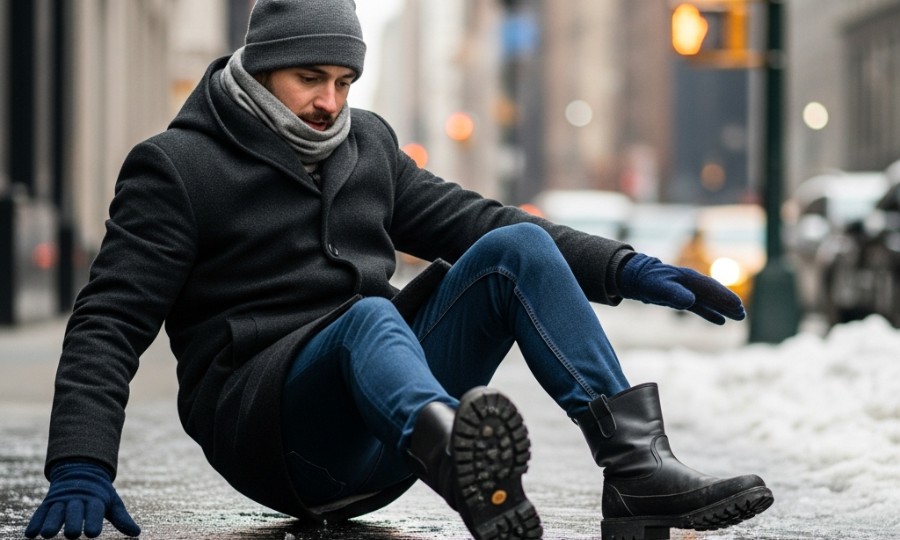
You’re out enjoying a crisp New York City winter day – maybe heading to your favorite coffee shop or just running errands. Then, without warning, a patch of hidden ice sends you sprawling. One moment you’re upright, the next you’re on the cold, hard pavement, feeling a jolt of pain and maybe a whole lot of embarrassment. It’s an all-too-common scenario in our city, isn’t it?
When winter weather descends upon NYC, icy sidewalks become a real hazard. But here’s the thing: while slips and falls might seem like an unavoidable part of the season, they often stem from someone else’s negligence. Understanding your legal rights after a winter slip and fall in NYC is absolutely crucial. You don’t have to navigate the aftermath alone, especially if your injury was preventable.
Understanding Property Owner Responsibility in NYC
In New York City, property owners, whether they’re individuals, businesses, or even the city itself, have a legal duty to maintain their premises in a reasonably safe condition for visitors. This duty extends directly to managing snow and ice. We’re not talking about a sudden blizzard that just hit; we’re talking about conditions that have been left untended, creating a dangerous situation. Generally speaking, property owners are expected to take reasonable steps to clear snow and ice within a certain timeframe after precipitation stops. This is often referred to as the “reasonable time” rule.
For instance, under the New York City Administrative Code § 16-123, owners of property abutting sidewalks are responsible for removing snow, ice, or other obstructions from the sidewalk within four hours after the snow has ceased to fall, or the formation of ice has stopped. If the snow or ice falls or forms between 9 p.m. and 7 a.m., they have until 11 a.m. the following morning — the overnight hours do not count toward the four-hour clock, so snow that stops in the evening pauses the clock at 9 p.m. and resumes it at 7 a.m. Sounds pretty clear, right? But what if they don’t? What if a patch of ice has been there for days, slowly turning into a treacherous, invisible hazard? This is where understanding your NYC winter slip and fall rights truly comes into play.
Let’s consider a practical example: Imagine you’re walking past a small commercial storefront in Brooklyn. It snowed heavily three days ago, and while most of the street is clear, the owner of this store never bothered to shovel their section of the sidewalk. The snow has now melted and refrozen into a slick, uneven sheet of ice right in front of their entrance. You slip, fall, and break your wrist. In this scenario, the property owner likely failed in their duty of care, and you may have a strong case for negligence.
What to Do Immediately After an Icy Slip and Fall
It’s easy to feel flustered, embarrassed, or even overwhelmed right after a fall. Your adrenaline is pumping, and your first instinct might be to just get up and go. But taking a few critical steps immediately can significantly impact any potential legal claim you might pursue. Think of it as laying the groundwork for your future self.
- Seek Medical Attention: Even if you don’t think you’re seriously hurt, get checked out by a doctor. Some injuries, like concussions or soft tissue damage, might not manifest fully until hours or even days later. A medical record creates an official timestamp of your injury, which is vital evidence.
- Document Everything: If you can, take photos and videos of the scene. Get close-ups of the ice, the surrounding area, and any warning signs (or lack thereof). Note the time, date, and exact location. Were there any witnesses? Get their contact information! (They don’t have to be friends; even a passerby’s testimony can be invaluable.)
- Report the Incident: If you fell on private property (like a store, apartment building, or office), report the fall to the property owner, manager, or landlord immediately. Ask for an incident report and get a copy. If you fell on a public sidewalk, it can be trickier, but documenting the location thoroughly is key.
You might be thinking, “But what if I just want to forget about it?” That’s a natural reaction. However, injuries can have lasting impacts, affecting your work, your daily life, and your financial well-being. Protecting your rights by taking these initial steps ensures you have options down the line.
The “Reasonable Time” Rule and Constructive Notice
We touched on the “reasonable time” rule, but let’s dive a bit deeper, as it’s a cornerstone of many NYC slip and fall cases. For a property owner to be held liable, they generally must have had “notice” of the dangerous condition. This notice can be either “actual” or “constructive.”
- Actual Notice: This means the property owner or their employees actually knew about the hazardous ice. Maybe someone complained, or they saw it themselves.
- Constructive Notice: This is where the “reasonable time” comes in. It means the dangerous condition (the icy patch) existed for such a length of time that the property owner should have known about it and, therefore, had a reasonable opportunity to fix it. If that icy patch outside the Brooklyn storefront had been there for three days, it’s highly probable the owner had constructive notice.
This “reasonable time” isn’t a hard-and-fast rule for every single scenario, especially when you consider refreezing or melting cycles. But generally speaking, it implies a period long enough for a diligent property owner to have discovered and remedied the hazard. This is why photos with timestamps are incredibly powerful evidence. They help establish how long the dangerous condition was present.
Public vs. Private Property: Who’s Accountable?
The question of who is accountable after an icy fall often depends on where the fall occurred. If you slip on a private property’s steps, the owner is typically responsible. But what if it’s a city sidewalk?
In New York City, the responsibility for maintaining sidewalks generally falls on the abutting property owners, not the City itself. This is a significant distinction from many other municipalities. So, if you fall on an icy sidewalk in front of an apartment building, it’s usually the building owner, not the City of New York, who is liable. However, there are exceptions. For example, if the City itself created the dangerous condition (e.g., a broken water pipe that froze) or if it’s a city-owned property (like a park path), then the City might be held responsible. Cases against the City often have different notice requirements and shorter statutes of limitations, which is another reason why timely action and legal counsel are so important.
Think about this: You’re walking past a municipal park in Manhattan, and the path inside the park is a skating rink because a city employee neglected to salt it after a light snowfall. If you fall there, your claim would likely be against the City of New York, subject to specific filing requirements, including a Notice of Claim that must be filed within 90 days of the incident. That’s a much tighter window than a typical personal injury claim!
Gathering Evidence: Your Key to a Strong Claim
We’ve talked about documentation, but let’s emphasize its importance. A personal injury claim isn’t just about what happened to you; it’s about proving it. The more evidence you have, the stronger your position will be. Here’s a breakdown:
- Photographs and Videos: As mentioned, these are gold. Capture the specific patch of ice, the overall condition of the sidewalk/property, and any surrounding elements like poor lighting or broken drainage that might have contributed.
- Witness Statements: Independent witnesses provide objective accounts. A brief written statement or even just their contact information can be invaluable.
- Medical Records: Detailed records from your doctor, hospital, or physical therapist are crucial. They link your injuries directly to the fall and document the extent of your pain and recovery process. Don’t underestimate the power of these records; they tell your story from a medical perspective.
- Incident Reports: Any official report filed with the property owner or manager.
- Weather Reports: Official meteorological data can help establish when precipitation occurred and when the property owner’s duty to clear began.
- Clothing/Footwear: While not always necessary, if your footwear was appropriate for winter conditions, it helps counter any claims of your own negligence.
It’s easy to overlook some of these details in the immediate aftermath of a painful fall, but I believe that taking a moment to gather as much as you can will ultimately serve your best interests. You might think this won’t work because you were too hurt to take photos, and that’s perfectly understandable. In such cases, a skilled attorney can help investigate and gather this evidence after the fact.
Common Defenses and How to Counter Them
Property owners and their insurance companies aren’t just going to hand over a check. They’ll often employ various defenses to minimize or deny your claim. Knowing these can help you prepare.
- Lack of Notice: “We didn’t know the ice was there.” This is why proving constructive notice (that it was there long enough they should have known) is so important.
- “Open and Obvious” Condition: “The ice was visible; you should have seen it and avoided it.” While you do have a duty to watch where you’re going, ice can be surprisingly hard to see, especially black ice or uneven patches. Your attorney can argue that it wasn’t as “obvious” as they claim, or that despite its visibility, it was still a hazard that should have been cleared.
- Your Own Negligence (Comparative Negligence): “You were wearing inappropriate shoes,” or “You were distracted.” New York is a “pure comparative negligence” state. This means if you are found to be partly at fault for your fall, your compensation might be reduced by your percentage of fault, but you can still recover damages. For example, if you’re found 20% at fault, your award would be reduced by 20%.
- “Storm in Progress” Defense: “It was still snowing/raining, so we weren’t obligated to clear it yet.” This is a valid defense, but it only applies while the storm is actively ongoing. Once it stops, the “reasonable time” clock starts ticking.
Navigating these defenses requires a nuanced understanding of New York law and a keen eye for detail. This is where professional legal guidance really shines.
Why Legal Guidance is Essential for NYC Slip and Fall Cases
We know this feels overwhelming, especially when you’re recovering from an injury. The legal landscape surrounding slip and falls in NYC, particularly those involving winter conditions, is complex. There are specific rules, deadlines, and legal precedents that can make or break your case. Trying to go it alone against an insurance company or a property owner with legal counsel can feel like an uphill battle.
An experienced personal injury attorney who specializes in NYC slip and fall cases can:
- Investigate your accident thoroughly, gathering all necessary evidence (even if you couldn’t at the scene).
- Determine who is liable, whether it’s a private owner, a commercial entity, or potentially the city.
- Help you understand the true value of your claim, including medical expenses, lost wages, pain and suffering, and future medical needs.
- Negotiate with insurance companies on your behalf, protecting you from lowball offers.
- Represent you in court if a fair settlement cannot be reached.
Don’t let the complexities of the legal system prevent you from seeking the compensation you deserve. If you’ve been injured in an icy slip and fall in New York City, your next step should be to consult with a qualified attorney. They can provide clarity, advocate for your rights, and help you focus on what truly matters: your recovery. Why wait when you could be getting expert advice today?
This article was drafted with AI assistance. Please verify all claims and information for accuracy. The content is for informational purposes only and does not constitute professional advice.
Free Case Consultation
Injured in an accident? Speak directly with an experienced NYC personal injury attorney at
Rosenberg, Minc, Falkoff & Wolff. Your consultation is free, confidential, and risk-free.
No obligation • No upfront fees • You don’t pay unless we win