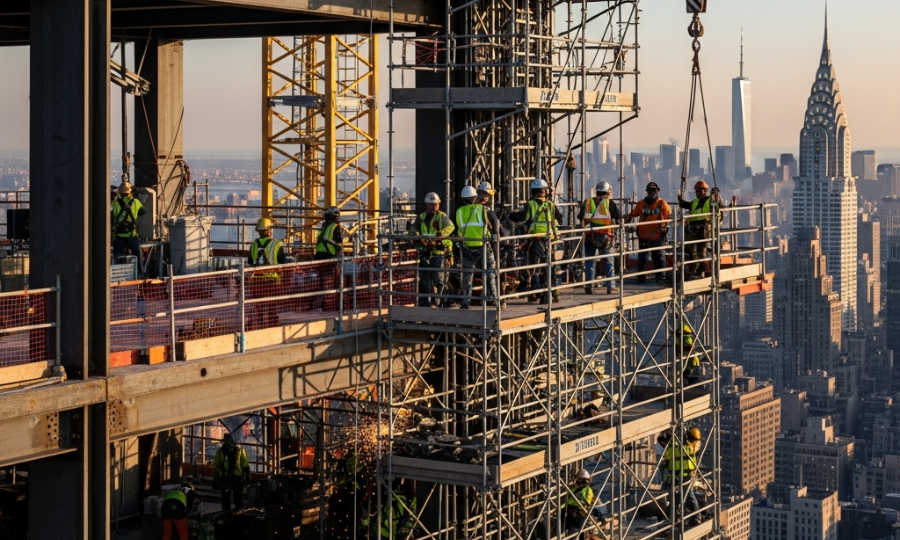
Understanding New York Labor Law 240
Working on a job site in New York City carries serious risks every day. High elevation scaffolds and heavy suspended equipment create dangerous conditions for hard-working crews. Fortunately, state legislation offers vital protections for injured workers. As a top NYC personal injury lawyer, our firm helps injured craftspeople understand their legal rights after devastating accidents.
Key Takeaways
- New York Labor Law Section 240 imposes strict liability on site owners and general contractors for height-related falls when a statutory violation is proven, but worker negligence can eliminate damages entirely if it is the sole proximate cause with no statutory violation.
- Attorneys routinely win summary judgment on liability under Section 240, shifting the court focus entirely to proving the value of catastrophic damages like brain injuries.
- Section 240 works alongside Section 241(6) for Industrial Code violations and Section 200 for general site negligence to secure maximum recovery for injured workers.
New York Labor Law Section 240(1) serves as a primary shield for jobsite safety. According to a report by Chubb, lawmakers originally enacted Section 240 in 1885 to protect workers from gravity-related hazards. Consequently, property owners and general contractors must provide proper safety gear for elevated work.
Therefore, owners must supply secure scaffolding, stay ropes, ladders, and hoists. If a contractor fails to provide proper safety devices, severe accidents occur. Plus, the statutory protections apply across all five boroughs, from Brooklyn rise projects to Manhattan commercial sites.
The Meaning of Strict Liability Under the Scaffold Law
Many injured workers worry that making a mistake on the job ruins their case. However, New York legal standards offer strong protections in height-related claims. Section 240 imposes strict liability on building owners and general contractors in certain circumstances. Consequently, Under Section 240, comparative negligence cannot reduce damages once a statutory violation is proven, but worker fault can eliminate financial recovery entirely if the worker is the sole proximate cause with no statutory violation.
First, strict liability means you do not have to prove the owner acted with general carelessness. Instead, you only need to show a statutory violation occurred. For example, if a safety harness breaks or a ladder slips, the owner is responsible. In addition, comparative fault rules do not reduce your financial compensation under this specific statute.
Next, strict liability applies directly to elevation hazards. The legal threshold remains focused on gravity risks. The decisive test for Section 240 is whether injuries directly resulted from a failure to protect against a physically significant elevation differential, according to the New York Court of Appeals in Runner v. New York Stock Exchange, Inc., which was quoted in Brown v. 44TH St. Dev., LLC. As a result, Both falling from heights and being struck by falling objects can fall under Section 240, but only when they involve qualifying construction activities, significant elevation-related gravity hazards, and failure of required safety devices.
How Severe Worksite Elevation Falls Cause Brain Injuries
Falls from elevated platforms routinely cause life-altering physical trauma. Traumatic brain injuries represent some of the most devastating outcomes on modern jobsites. Brett Nomberg Law noted that elevated falls and falling object strikes governed by Section 240 frequently cause permanent cognitive damage. Consequently, injured tradespeople often require continuous, long term medical support.
Also, brain injuries alter every aspect of a worker’s daily living. A severe fall can cause skull fractures, concussions, and deep brain contusions. In addition, brain swelling can damage vital neural pathways. Therefore, an injured worker may struggle with speech, memory, and physical coordination for the rest of their life.
Plus, catastrophic brain damage ends careers abruptly. Skilled carpenters, electricians, and union ironworkers suddenly lose their ability to work in their trade. Brett Nomberg Law emphasized that traumatic brain injuries lead to permanent loss of future earning capacity. Consequently, legal claims must reflect lifetime financial losses alongside medical bills.
Winning Summary Judgment on Section 240 Liability
Establishing absolute legal responsibility early changes the direction of a court case. Frekhtman & Associates explained that personal injury attorneys frequently win summary judgment on liability under Labor Law 240 before trial begins. Therefore, judges rule on legal liability early, leaving only financial damages for trial.
First, your attorney gathers critical physical evidence from the site. Photos of defective ladders, broken safety harnesses, and failed hoist systems build a strong record. Meanwhile, witness statements from fellow crew members confirm how the incident occurred.
In addition, securing summary judgment removes immense pressure from the injured party. Once the court establishes owner liability, defense lawyers can no longer blame the worker. Consequently, the legal focus shifts entirely toward securing maximum financial compensation for long term care costs.
Combining Labor Law Statutes for Maximum Financial Protection
Labor Law 240 forms a powerful shield, but attorneys often pair it with other state codes. Building a comprehensive legal strategy ensures complete coverage for medical harm. The Perecman Firm detailed how Labor Law 200, 240, and 241 work together in New York construction claims.
First, Labor Law Section 241(6) targets specific safety rule violations. This statutory section mandates compliance with the detailed regulations in the New York State Industrial Code. For example, if site managers fail to guard open elevator shafts or remove tripping hazards, Section 241(6) applies directly.
Next, Labor Law Section 200 establishes general worksite negligence standards. This statute codifies the common law duty of site owners to maintain reasonably safe working environments. Therefore, pairing Section 200 and Section 241(6) with Section 240 creates multiple pathways toward full compensation.
Financial Impact and Proven Case Verdicts
Catastrophic brain injuries demand extensive financial resources for medical care and physical therapy. Fortunately, New York legal protections yield major financial results for impacted families. Section 240 litigation has been associated with significant construction payouts across New York City. A $53.5 million Brooklyn construction fall verdict occurred, but its connection to any ‘NYC Labor Law Report’ cannot be verified from independent sources.
In addition, specific case outcomes show the vital protection offered to union workers. A $7.1 million settlement under Labor Law 240 was secured for a union steam fitter in Manhattan. A heavy pipe fell from above, knocking the steam fitter off a ladder and causing catastrophic injuries.
Consequently, these major financial settlements provide lifelong care for injured tradespeople. Multi-million dollar recoveries cover specialized housing, continuous nursing care, and lost income. Therefore, hiring experienced counsel remains critical after an elevated fall.
Proving the Full Extent of Traumatic Brain Damage
Proving invisible brain damage requires sophisticated expert analysis and testimony. Insurance defense firms routinely downplay head injuries without visible open wounds. However, our Queens car accident attorneys and NYC construction injury team know how to expose hidden trauma.
First, medical specialists evaluate neurological function using advanced imaging technology. Diffusion tensor imaging and high resolution MRI scans uncover microscopic axonal damage. In addition, neuropsychologists conduct extensive cognitive testing to map memory loss and executive function deficits.
Next, life care planners calculate future medical needs over the worker’s lifespan. These experts account for medication costs, specialized therapies, home modifications, and daily assistance. Also, forensic economists calculate past inflation, rising healthcare costs, and lost future union benefits. Consequently, the legal team presents a complete financial picture to the jury.
What to Do Immediately After a Worksite Elevation Accident
Taking immediate steps after an accident protects your health and legal rights. If you suffered an injury in a Brooklyn construction accident or any NYC jobsite fall, swift action makes a decisive difference.
First, seek immediate emergency medical care. Tell hospital doctors exactly how the accident happened and report every symptom, including head impact or dizziness. Medical records created right after the fall serve as foundation evidence for your claim.
Next, notify your site supervisor or project foreman about the incident immediately. Ensure site management files an official written incident report. However, do not sign statements for insurance investigators without consulting a lawyer.
Finally, contact a qualified legal representative right away. An experienced legal team will preserve site evidence, inspect defective equipment, and handle communication with insurance adjusters. Consequently, you can focus fully on your physical recovery while your lawyer fights for justice.
How Our Experienced NYC Construction Injury Law Firm Helps
Navigating the aftermath of a catastrophic jobsite injury feels overwhelming for families. You face steep medical bills, lost paychecks, and painful physical rehabilitation. However, you do not have to fight powerful real estate owners and insurance carriers alone.
Our firm brings decades of local trial experience to every client claim. We understand New York Labor Law, safety standards, and local court procedures inside and out. Also, we work with top medical experts to document catastrophic brain damage completely.
In addition, we handle all personal injury claims on a contingency fee basis. You pay no upfront costs or legal fees unless we successfully recover money for you. Therefore, you gain top tier legal representation without financial stress.
Take Action to Protect Your Future Today
If you or a loved one suffered a catastrophic brain injury from a jobsite fall, time is limited. Strict statutory deadlines apply to notice requirements and court filings across New York State. Delaying legal action can compromise vital evidence and weaken your claim.
Contact our dedicated legal team today to schedule a free, confidential case review. We will evaluate your accident, explain your rights under Labor Law 240, and chart a clear path forward. Let us handle the legal burden while you focus on healing.
Sources
- Justia Law, Brown v 44TH St. Dev., LLC
This article was drafted with AI assistance. Please verify all claims and information for accuracy. The content is for informational purposes only and does not constitute professional advice.
Free Case Consultation
Injured in an accident? Speak directly with an experienced NYC personal injury attorney at
Rosenberg, Minc, Falkoff & Wolff.
Your consultation is free, confidential, and risk-free.
No obligation – No upfront fees – You don’t pay unless we win
Follow RMFW Law for legal insights and case results: