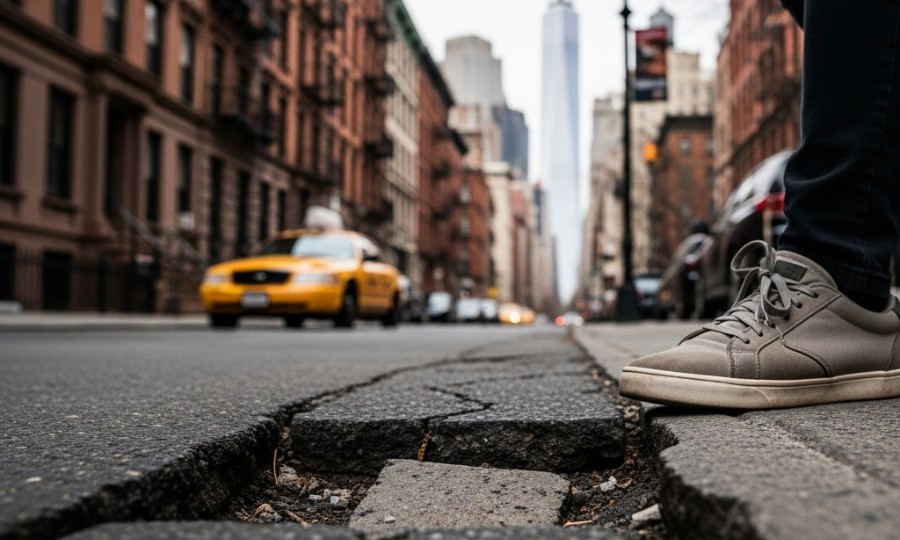
Imagine this: you’re walking along a busy street in New York City, perhaps enjoying a bagel or rushing to a meeting. Suddenly, your foot catches on a raised slab of concrete, or you hit an unexpected patch of black ice, and down you go. It’s disorienting, painful, and frankly, pretty frustrating. But once the initial shock wears off, a crucial question often arises: who is actually responsible for that sidewalk? Is it the city, the property owner, or perhaps even you?
Navigating a slip and fall claim in New York City isn’t like navigating one anywhere else in the country. Here, the rules are uniquely complex, primarily due to a specific piece of legislation that dramatically shifted liability. We’re going to unravel these complexities, helping you understand who might be on the hook if you suffer an injury on an unsafe NYC sidewalk.
The Unique Landscape of NYC Sidewalk Liability
For many years, if you slipped and fell on a city sidewalk due to a defect, your primary target for a lawsuit would typically be the City of New York. Makes sense, right? They own the sidewalks. But that all changed with the enactment of New York City Administrative Code § 7-210 in 2003. This law fundamentally altered who is responsible for maintaining most sidewalks within the five boroughs.
Here’s the thing: § 7-210 transferred the duty to maintain sidewalks in a reasonably safe condition from the City to the owners of property adjacent to those sidewalks. This means commercial property owners, owners of mixed-use buildings, and even many residential property owners are now generally responsible for the upkeep of the sidewalk directly in front of their premises. It’s a significant departure from common law, and it’s critical for anyone living in or visiting NYC to understand. What does this mean for you if you fall? It means you’ll likely be looking at the adjacent property owner, not the City, as the potentially liable party.
Who’s on the Hook? Understanding Property Owner Duties
So, who exactly is an “adjacent property owner” in this context? Generally speaking, it refers to owners of commercial properties, office buildings, apartment complexes (not 1-3 family owner-occupied, we’ll get to that exception), and even vacant lots. These owners are now tasked with keeping their sidewalks free from hazardous conditions like:
- Cracked or Uneven Pavement: Trip hazards caused by broken or displaced concrete slabs.
- Potholes and Depressions: Unexpected dips that can cause a loss of balance.
- Tree Roots: Sidewalk damage caused by encroaching tree roots, often lifting sections of concrete.
- Obstructions: Items left on the sidewalk that create a tripping hazard.
- Ice and Snow: A major concern, especially during our tough New York winters.
For a property owner to be held liable, they generally need to have had “notice” of the dangerous condition. This can be “actual notice,” meaning they were directly informed of the problem, or “constructive notice,” meaning the condition existed for a long enough time that a reasonable property owner should have discovered and fixed it. For example, if a large crack has been visible on a sidewalk for months, it’s hard for an owner to claim they didn’t know about it, isn’t it?
When Does the City Still Bear Responsibility? (It’s Not Always the Property Owner!)
While Administrative Code § 7-210 shifted a lot of responsibility, it didn’t completely let the City off the hook. There are crucial exceptions where the City of New York can still be held liable for sidewalk slip and fall accidents. You might be thinking, “But you just said it’s the property owner!” And you’d be right, mostly. But here’s where it gets nuanced:
One-to-Three Family Owner-Occupied Residences: This is the big one. If the sidewalk abuts a one, two, or three-family residential property where the owner actually lives, the duty of maintenance often reverts back to the City. This exception was put in place to protect individual homeowners from the significant financial burden of sidewalk repairs and liability. So, if you fall in front of a brownstone where the owner lives, the City could still be liable.
“Special Use” Sidewalks: The City retains responsibility for certain areas of the sidewalk that are designated for “special use” or are not part of the general pedestrian pathway. Think about things like bus stops, subway entrances, utility grates, or even where a sidewalk crosses a driveway cut-out. These areas often fall under the City’s purview, not the adjacent property owner’s.
City-Created Defects: If the City itself created the dangerous condition through its own negligence – perhaps during a street repair project or by improperly installing a sign – then it can still be held liable. The same applies if the City performed a repair poorly, making the sidewalk more dangerous.
Prior Written Notice: This is critical for any claim against the City. Unlike private property owners, the City generally cannot be held liable for a sidewalk defect unless it received “prior written notice” of that specific defect and failed to fix it within a reasonable time. This notice usually comes in the form of a complaint filed with the Department of Transportation (DOT) or another city agency, often via a Big Apple Pothole and Sidewalk Protection Committee map. Without this specific notice, suing the City is incredibly challenging, if not impossible.
Gathering Evidence: Your Crucial First Steps After a Fall
Falling on an NYC sidewalk can be painful and embarrassing, but your actions immediately afterward can be vital for any potential claim. Don’t just pick yourself up and walk away if you can help it. Here’s what you should do:
- Document the Scene: If you’re able, take photos and videos of the exact location where you fell. Get close-ups of the defect (the crack, the ice, the uneven slab) and wider shots that show its surroundings and the adjacent property.
- Seek Medical Attention: Even if you think it’s just a bruise, get checked out by a doctor. Some injuries, like concussions or soft tissue damage, might not be immediately apparent. This also creates an official record of your injuries.
- Identify Witnesses: Did anyone see you fall? Get their contact information. Their testimony can be invaluable.
- Note the Property: Look at the building or property adjacent to where you fell. Is it a commercial building, an apartment complex, or a small family home? This helps determine who the potential defendant might be.
The Complexities of Ice and Snow: A Seasonal Challenge
Winter in NYC brings a whole new layer of liability to sidewalk claims. Property owners (under § 7-210) and, in some cases, the City, have a duty to clear snow and ice from sidewalks. But it’s not instantaneous; there’s a “reasonable time” clause.
Generally, property owners are expected to clear snow and ice within a certain period after a storm ceases, usually four hours, not including nighttime hours (9 PM to 7 AM). If the snow or ice has been present for longer than that and created a dangerous condition leading to your fall, the property owner could be liable. What about black ice? It’s often invisible, making it particularly dangerous. If a property owner knew or should have known about a recurring ice problem, or if they failed to properly clear snow, leading to refreezing, they could still be held accountable. These cases can be tricky, as proving a property owner’s negligence in snow and ice removal often requires demonstrating they didn’t act reasonably under the circumstances.
Navigating the Legal Maze: Why You Need an Expert
As you can see, determining liability in an NYC sidewalk slip and fall claim is rarely straightforward. It involves understanding specific administrative codes, identifying property types, and proving notice of a dangerous condition. It’s a lot to handle, especially when you’re recovering from an injury.
That’s why consulting with an experienced personal injury attorney is so crucial. They can help you:
- Identify the correct liable party (or parties) – is it the property owner, the City, or both?
- Investigate the scene and gather critical evidence, including property records, weather reports, and notice maps.
- Navigate the strict deadlines, known as statutes of limitations, for filing a claim. For instance, claims against the City often have much shorter notice requirements (often 90 days to file a Notice of Claim) than claims against private entities.
- Evaluate the full extent of your damages, including medical expenses, lost wages, and pain and suffering.
A slip and fall isn’t just an inconvenience; it can lead to serious injuries and significant financial burdens. Don’t let the complexity of NYC’s sidewalk laws deter you from seeking justice. We know this feels overwhelming, but with the right guidance, you can confidently pursue the compensation you deserve. Why go it alone when expert help is available?
If you’ve suffered an injury on an NYC sidewalk, don’t hesitate. Reach out to a qualified legal professional today to discuss your options. You’ve got enough on your plate recovering; let someone else handle the legal heavy lifting.
This article was drafted with AI assistance. Please verify all claims and information for accuracy. The content is for informational purposes only and does not constitute professional advice.
Free Case Consultation
Injured in an accident? Speak directly with an experienced NYC personal injury attorney at
Rosenberg, Minc, Falkoff & Wolff.
Your consultation is free, confidential, and risk-free.
No obligation • No upfront fees • You don’t pay unless we win